


Outdoor Composite Fencing - 18, 20 and 22 mm Boards on 90 × 90 or 100 × 100 mm Posts
This is the outside boundary in board and post form. Boards come in 18, 20 and 22 mm, 20 mm as stock. Posts come in 90 × 90 and 100 × 100 mm, with the section chosen by exposure rather than panel height alone.
Thickness buys stiffness, not looks. A 22 mm board holds a longer edge and a wider bay than an 18 mm, and costs more per metre for the same face.
Outdoors the board meets four things: sun, water, ground contact and salt. The compound and the joint detail answer sun and water. The bottom rail answers ground contact. The fixing grade answers salt, because a fence fails at its fasteners first.
The face carries a 20-year fade claim. It rests on grade 4–5 to ISO 105-A02 on a xenon arc test, and the exposure hours behind that grade are on the lot report. The claim covers the board face, not the fixings.

Specifications
A lot is released against these values, and its report travels with it.
|
Property |
Value |
Standard / note |
|
Board thickness |
18, 20 and 22 mm |
20 mm stock; 16–25 mm to order |
|
Post section |
90 × 90 and 100 × 100 mm |
100 × 100 on exposed runs |
|
Compound |
Wood fibre, HDPE, UV stabilizer, biocide |
No formaldehyde, no heavy-metal additive |
|
Water absorption |
< 0.5% |
ISO 62, 24-hour immersion |
|
Flexural strength |
≥ 24 MPa |
ASTM D790 |
|
Colour fastness |
Grade 4–5 |
ISO 105-A02, xenon arc |
|
Surface |
Embossed grain, brushed or smooth |
Grain rolled during extrusion, not printed |
|
Colours |
Dark brown, light grey, carbon black |
Plus 2 more grains; custom tone on a batch |
|
Fire |
Flame-retardant formulation |
Class to EN 13501-1 on the lot report |
|
Fixings |
Stainless, grade by exposure |
316 where salt reaches the boundary |
|
Certification |
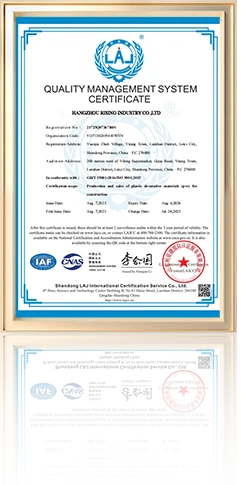
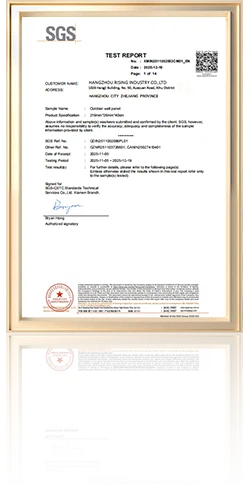
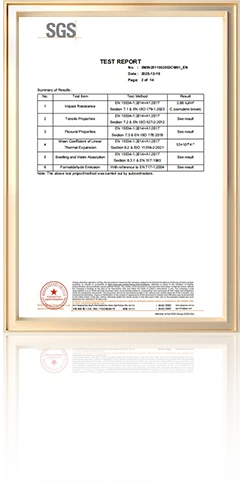
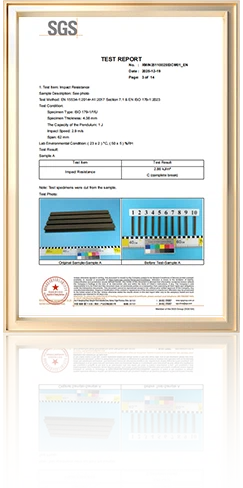
EN 15534 test report · ISO 9001 |
CE marking where a DoP is issued |
|
MOQ |
200 m, or 50 sets, a set being one bay with posts and caps |
Mixed thicknesses quoted together |
|
Delivery |
15–30 days |
After deposit and colour approval |
One row decides more projects than the rest. Water absorption below 0.5% is what lets the board sit at the bottom rail through a wet winter, and it separates this from a timber panel.
Choosing Board Thickness and Post Section
Six exposures cover most boundaries. Check the post column first: the post is what fails, not the board.
|
Exposure |
Board |
Post |
Why |
|
Sheltered garden to 1.5 m |
18 mm |
90 × 90 |
Short bay, low wind; ground contact is the risk |
|
Standard garden to 1.83 m |
20 mm |
90 × 90 |
The default specification for a domestic boundary |
|
Exposed frontage |
22 mm |
100 × 100 |
Long unsupported edge, and gusting across a face |
|
Coastal boundary |
20 mm |
100 × 100 |
Salt attacks the fixing; exposed wind sets the post |
|
Pool surround |
20 mm |
90 × 90 |
Splash and chlorine, not wind load |
|
Boundary over 1.83 m |
22 mm |
100 × 100 |
Larger wind area; post needs an engineer's number |
Two rows are often specified the wrong way round. A coastal site upgrades the board and leaves the fixing, when salt reaches the screw first. A pool surround upgrades the post, when splash is the exposure and drainage is the fix.
A thicker board is not automatically a stronger fence. A 22 mm board on a 90 × 90 post still fails at the post. A 100 × 100 post carries 23 per cent more section area than a 90 × 90, and stiffness rises faster than that. The post is the efficient half of a wind upgrade.
Compared with Timber, PVC and Aluminium Fencing
Four outdoor materials are compared where a boundary actually fails, including where this one loses.
|
Criteria |
WPC board |
Timber |
PVC panel |
Aluminium |
|
Water |
< 0.5% absorption |
Swelling and rot |
Unaffected |
Unaffected |
|
Sun |
UV stabilizer in the compound |
Greys and splits |
Chalks and yellows |
Coating fades |
|
Ground contact |
Stable to the bottom rail |
Rots at the base |
Stable |
Stable, but stains |
|
Impact |
Dents, does not shatter |
Cracks at a knot |
Brittle in cold |
Dents and shows it |
|
Repair |
Replace the board |
Replace the board |
Replace the panel |
Replace the panel |
|
Look |
Wood grain, warm |
Real wood |
Uniform, reads as plastic |
Metal, reads as commercial |
|
Cost per metre |
Middle |
Low, plus upkeep |
Low |
Highest |
|
Where it loses |
Not a security barrier; heavier than PVC; colour set is narrower than timber stains |
Cheapest first invoice |
Cheapest and lightest |
Lighter and non-combustible |
Price Factors
Five variables move the price per linear metre:
Board thickness
22 mm uses about 22 per cent more compound than 18 mm across the same face, and that lands in the metre rate.
01
Post section
100 × 100 carries more material per post, and it is the cheaper way to stiffen a run.
02
Colour
Three stock colours run without a set-up. A bespoke tone needs a batch run and a longer lead time.
03
Surface
A rolled grain adds a pass at the die. Smooth board is the cheaper face and the one that shows marks.
04
Run and fixing
Long runs price lower per metre; 316 fixings and footings are separate lines. A 50 m boundary is 27 bays and 28 posts, which is the count to price.
05
The cheapest metre is 18 mm board, 90 × 90 post, stock colour, smooth face, full container. Every step away is itemised on the quotation, not folded into the rate.
Quality Control and Loading
Four records per container
|
Record |
What it covers |
Issued at |
|
Compound record |
Wood-fibre to HDPE ratio, stabilizer and biocide dose |
Mixing |
|
Thickness and profile |
Board gauge, interlock, straightness over the length |
After extrusion |
|
Colour and surface |
Grain and tone against the retained reference board |
After embossing |
|
Loading check |
Board count, post sections and fixing grade |
Before loading |
The fixing grade is checked at loading, not at packing. A 316 order that ships with 304 screws passes every earlier inspection and fails in service, so the grade is written on the bundle label.
A claim is settled on those records. The bundle label ties a short delivery to a lot.
Packing and loading
|
Item |
Detail |
|
MOQ |
200 m, or 50 sets |
|
20' GP |
Quoted on the load plan |
|
40' HQ |
≈ 2,800–3,200 linear m, thickness dependent |
|
Lead time |
15–30 days after deposit |
|
Port of loading |
Ningbo / Shanghai |
|
Packing |
Bundled, corner-protected, on timber bearers |
|
Marking |
Colour batch, thickness, fixing grade |
Corner boards protect the cut ends, and bundles ride on bearers, not the container floor. A board that takes a set in transit bows once on the post.
Transit damage is settled on the loading photographs, and end damage visible there is replaced with the next shipment at our cost. Claims are accepted within 7 days of arrival.
Application Scenarios
Eight outdoor settings cover most of what ships. Each row pairs a specification with the question to settle.

Villa courtyard
Warm face against planting; luxury private villa perimeter boundaries, courtyard garden screening and landscaping partitions.
• Specification: 20 mm, 90 × 90, dark brown
• Settle before ordering: Boundary line and height covenant

Coastal plot
Salt reaches the screw first; exposed beachfront property perimeters, high wind-load resistance and marine-grade anti-corrosion boundary runs.
• Specification: 20 mm, 100 × 100, 316 fixings
• Settle before ordering: Distance to the shoreline and wind exposure rating

Pool side
Splash, and a cool face underfoot; private and resort swimming pool surrounds, splash-resistant safety boundary with clean drainage integration.
• Specification: 20 mm, 90 × 90, light grey
• Settle before ordering: Drainage away from the post base and chlorine splash resistance

Roof terrace
Light panel on a raised deck; penthouse rooftop terrace privacy screening, elevated garden dividers and wind-break panels on timber/composite subframes.
• Specification: 18 mm, 90 × 90
• Settle before ordering: Wind uplift calculations and fixing details to the structural deck joists

Cafe and restaurant
Screens a seating area; commercial hospitality outdoor dining enclosures, sidewalk bistro patio dividers and street-front privacy partitions.
• Specification: 20 mm, carbon black
• Settle before ordering: Fire class and reaction-to-fire standards required by local municipal code

Holiday park
Repeatable per plot; modular holiday resort cabin plot dividers, uniform leisure village boundaries and glamping perimeter fencing.
• Specification: 20 mm, stock colour
• Settle before ordering: Plot layout count, standard bay modules, and gate/access positions

Park and civic
Long run, public loading; heavy-duty municipal public park perimeter, pedestrian greenway trail boundaries and high-traffic civic landscaping barriers.
• Specification: 22 mm, 100 × 100
• Settle before ordering: Vandal resistance, public impact durability, and maintenance replacement policy

Balcony screen
Screens without a wall; multi-family apartment balcony privacy dividers, loggia acoustic and visual partitions without adding heavy masonry loads.
• Specification: 18 mm, 90 × 90
• Settle before ordering: Fixing base details, balcony balustrade attachment, and multi-family building regulations
Where this fence is not the answer
Where the boundary must stop people
A composite board is a screen: it resists weather, not force, and a determined entry takes minutes. Secure perimeters take steel.
Where a non-combustible boundary is required
The board is flame-retardant and does not reach A2. Within 1 m of a boundary, masonry or metal is the correct answer.
Where 316 fixings are ruled out on cost
304 screws tea-stain a white wall in a season on the coast. That is the wrong specification, not a maintenance problem.
Where the ground moves
Made ground and clay heave take a post out of plumb, and no board section corrects that. The footing is the fix, and it is outside this product.
Installation

Ground contact and drainage
The bottom rail sits clear of the soil. A board that touches earth holds water at its lower edge, and that edge is where a fence begins to fail, whatever the compound.
Water is led away from the post, not into it. A concrete collar that stands proud of the ground sheds water; a flat collar collects it at the base.
On a coastal site the fixings are the schedule, not an upgrade: 316 screws and brackets, no plain steel at a drilled hole, because one bare fixing stains the face below it.
Cleaning and colour over the years
Washing is the whole schedule. Soap, water and a soft brush clear pollen, bird lime and traffic film, none needs a solvent.
A dark board in full sun runs hotter than a light one, and heat moves a long panel. On a west-facing run, light grey holds shape better.
Judge colour in daylight against the retained board, not a photograph. A repeat order carrying its batch number is matched to that board; without the number, only the stock swatch is available.

Supply and Order
Price basis
The five variables above set the price, and the port sets the delivery term. Reply lands the same day with FOB or CIF, a bay plan and the CBM.
Container
The 40' HQ figure is the planning number. Two thicknesses can share a load, and the mix is settled on the load plan.
Production
Deposit to loading: 15–30 days. A custom colour adds a batch run, and the holiday shutdown needs booking ahead.
Paperwork
Lot report, loading photographs, packing list, SGS on request, customs certificates before the vessel.
Repeat orders
Quote the original batch number and the board is matched to the retained reference rather than a swatch. Without it, only the stock swatch can be matched.
Fixings
Posts, brackets, caps and trims travel with the boards at the grade the exposure needs.
Swatches
Sent free. Freight is the buyer's, dispatch in 3–5 days, and the charge comes off the first order.
Own brand
Logo on the wrap only, so the board face stays clean, and a minimum run applies.
Terms
30 per cent with the order, the balance against the bill of lading, or an L/C at sight.
Where it ships from
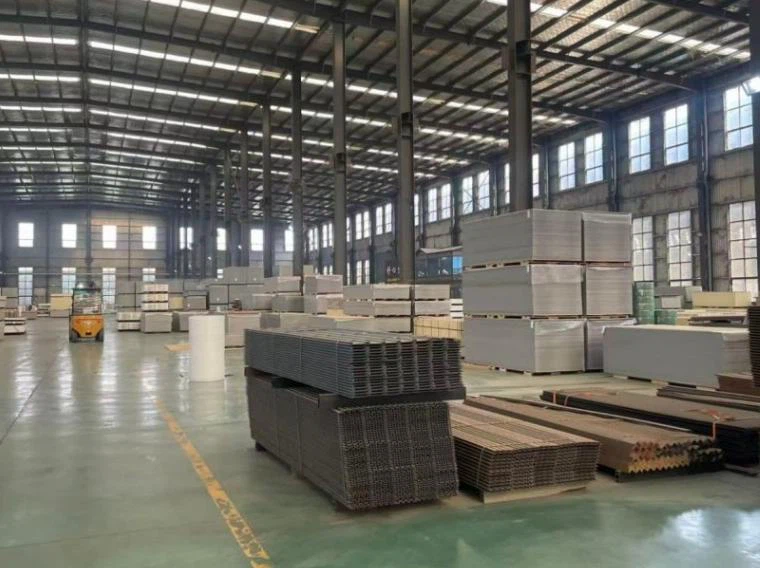
Boards are made in Hangzhou, Zhejiang, and leave through Ningbo or Shanghai.
Factory


Our Certificates

FAQ
Q: What material is your outdoor composite fence made of?
A: Our outdoor composite fence is made from wood/bamboo powder and HDPE through high-temperature composite processing. It is formaldehyde-free, heavy-metal-free, 100% recyclable, and meets green building material standards.
Q: How long does the composite fence last outdoors?
A: It has a service life of 15–30 years under normal use. With proper maintenance, it can last up to 50 years without cracking, warping or deforming, much longer than traditional solid wood fences.
Q: Does the composite fence require frequent maintenance?
A: No. It does not need painting or waxing. You only need to rinse it with clean water for daily care, which greatly reduces long-term maintenance costs.
Q: Can you customize color, size and thickness?
A: Yes. We support color and thickness customization (MOQ: 500 sqm). Standard thickness is 20mm, customizable from 16mm to 25mm. Multiple wood-grain colors and custom sizes/shapes are available.
Q: What scenarios are your composite fences suitable for?
A: They are widely used in villa courtyards, balconies, pool areas, parks, scenic spots, and outdoor spaces of cafes, restaurants, chain hotels and resorts, matching modern, New Chinese and other architectural styles.
Packaging & Shipping



Hot Tags: outdoor composite fencing, China outdoor composite fencing manufacturers, suppliers, factory


