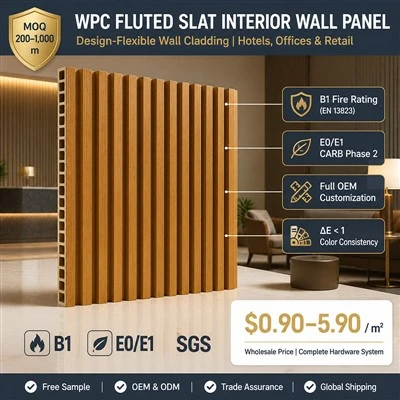
As a supplier of WPC (Wood - Plastic Composite) Panel Wood, I'm often asked about the heat insulation performance of our products. In this blog, I'll delve into the details of WPC Panel Wood's heat insulation capabilities, explaining why it's a great choice for various applications.


Understanding WPC Panel Wood
WPC Panel Wood is a composite material made by combining wood fibers or flour with thermoplastics and other additives. This combination creates a product that combines the natural look of wood with the durability and low - maintenance properties of plastics. One of the many advantages of WPC Panel Wood is its heat insulation performance.
The Science Behind Heat Insulation in WPC Panel Wood
The heat insulation ability of a material is mainly determined by its thermal conductivity. Thermal conductivity is a measure of how well a material can conduct heat. A material with low thermal conductivity is a good insulator, as it resists the transfer of heat.
In WPC Panel Wood, the wood fibers and plastic matrix contribute to its heat insulation performance. Wood fibers are natural insulators. They have a cellular structure that contains air pockets. Air is a poor conductor of heat, and these air pockets in the wood fibers act as barriers to heat transfer. When combined with the plastic matrix, which also has relatively low thermal conductivity, the overall WPC Panel Wood becomes an effective heat insulator.
Compared to traditional wood, WPC Panel Wood has enhanced heat insulation properties. Traditional wood can absorb moisture, and when it does, its thermal conductivity increases. Moisture - laden wood can conduct heat more easily. In contrast, WPC Panel Wood is more resistant to moisture absorption due to the plastic component. This means that its heat insulation performance remains relatively stable even in humid environments.
Applications Benefiting from WPC Panel Wood's Heat Insulation
Indoor Wall Cladding
Indoor wall cladding with Wpc Wood Wall Panel can significantly improve the energy efficiency of a building. By reducing heat transfer through the walls, it helps to maintain a stable indoor temperature. In winter, it keeps the warm air inside, reducing the need for excessive heating. In summer, it prevents the hot outside air from entering the building, thus lowering the cooling load. This can lead to substantial energy savings on heating and cooling costs.
Outdoor Fences
Outdoor fences made of Wpc Wall Paneling not only provide privacy and security but also have heat insulation benefits. In areas with extreme temperatures, the fence can act as a buffer, reducing the impact of the outside temperature on the interior of a property. For example, in a hot climate, the fence can block some of the solar heat from reaching the yard, making the outdoor space more comfortable.
Greenhouses
Greenhouses require strict temperature control to create an ideal environment for plants. Wall Wpc Panel can be used to construct greenhouse walls. Its heat insulation properties help to maintain a consistent temperature inside the greenhouse, protecting the plants from sudden temperature fluctuations. This is especially important during the night or in colder seasons when heat loss needs to be minimized.
Factors Affecting the Heat Insulation Performance of WPC Panel Wood
Density
The density of WPC Panel Wood can influence its heat insulation performance. Generally, a lower - density WPC Panel Wood has better heat insulation because it contains more air pockets within its structure. However, lower - density panels may be less strong and durable. So, a balance needs to be struck between density, heat insulation, and mechanical properties when manufacturing WPC Panel Wood.
Thickness
Thicker WPC Panel Wood panels offer better heat insulation. As heat has to travel through a greater distance in a thicker panel, more resistance is encountered, resulting in reduced heat transfer. When choosing WPC Panel Wood for insulation purposes, considering the appropriate thickness according to the specific application and insulation requirements is crucial.
Additives
Some additives can be incorporated into WPC Panel Wood to further improve its heat insulation performance. For example, certain types of insulating fillers can be added to increase the thermal resistance of the material. These additives work by creating additional barriers to heat transfer within the panel.
Testing and Certification
To ensure the quality and heat insulation performance of our WPC Panel Wood, we conduct rigorous testing. We use standardized testing methods to measure the thermal conductivity of our products. These tests are carried out in controlled laboratory environments to obtain accurate and reliable results.
In addition, our products comply with relevant industry standards and may have certifications related to energy efficiency and insulation. These certifications provide customers with confidence in the heat insulation performance of our WPC Panel Wood.
Comparison with Other Insulation Materials
When compared with other common insulation materials such as fiberglass and foam, WPC Panel Wood has its own unique advantages. Fiberglass insulation can be itchy and difficult to install, and it may pose health risks if the fibers are inhaled. Foam insulation can be expensive and may release harmful chemicals during the installation and aging processes.
WPC Panel Wood, on the other hand, is easy to install. It has a natural appearance, which makes it aesthetically pleasing for both indoor and outdoor applications. It is also environmentally friendly, as it can be recycled and is made from a combination of renewable wood fibers and recyclable plastics.
Conclusion
In summary, WPC Panel Wood offers excellent heat insulation performance, making it a versatile and practical choice for a wide range of applications. Its combination of natural wood fibers and plastic matrix, along with its resistance to moisture, contributes to its ability to reduce heat transfer. Whether it's used for indoor wall cladding, outdoor fences, or greenhouse construction, WPC Panel Wood can help to create a more energy - efficient and comfortable environment.
If you're interested in purchasing our high - quality WPC Panel Wood products, feel free to reach out to us for a detailed discussion. We can provide you with samples, answer your questions, and offer customized solutions based on your specific needs. Let's work together to achieve your insulation and construction goals with our exceptional WPC Panel Wood.
References
- ASTM International Standards on Thermal Conductivity Testing
- Industry reports on WPC materials and their properties