Hey there! As a supplier of WPC panel wood, I often get asked a bunch of questions from customers. One question that pops up quite a bit is, "Will WPC panel wood crack in cold weather?" Well, let's dig into this topic and find out.
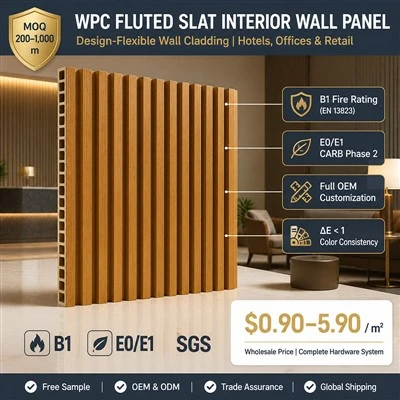
First off, what exactly is WPC panel wood? WPC stands for Wood - Plastic Composite. It's a material that combines wood fibers and thermoplastics. This combination gives it some unique properties. WPC panel wood is known for its durability, low maintenance, and aesthetic appeal. You can use it for various applications, like Wpc Wall Panelling, WPC Wall Cladding Interior, and Wpc Wall Panels Outdoor.


Now, back to the main question: cracking in cold weather. To understand this, we need to look at the behavior of the materials that make up WPC panel wood in low - temperature conditions.
Wood fibers are a natural material, and they have a certain degree of flexibility. However, in cold weather, they tend to become more brittle. The water content in the wood fibers can freeze, and when water freezes, it expands. This expansion can put stress on the wood fibers, potentially leading to cracks.
On the other hand, thermoplastics also have their own reaction to cold weather. Thermoplastics are polymers that can be melted and reshaped. In cold temperatures, they lose some of their flexibility and become stiffer. This change in the physical property of the thermoplastics can cause the overall WPC panel to become less forgiving when it comes to stress.
But here's the good news. High - quality WPC panel wood is designed to withstand these challenges. Manufacturers take into account the potential effects of cold weather during the production process. They use additives and special manufacturing techniques to improve the panel's resistance to low - temperature damage.
For example, some WPC panels are treated with anti - freezing agents. These agents help to prevent the water in the wood fibers from freezing, reducing the risk of expansion and cracking. Also, the ratio of wood fibers to thermoplastics is carefully calibrated. A proper balance ensures that the panel retains enough flexibility even in cold weather.
Another factor that affects whether a WPC panel will crack in cold weather is the installation. If the panels are installed incorrectly, they may be more prone to cracking. For instance, if the panels are installed too tightly without leaving enough room for expansion and contraction, the stress caused by temperature changes can be magnified. In cold weather, the panels will contract, and if there's no space for this movement, it can lead to cracks.
It's also important to consider the climate. In regions where the cold is extremely severe, like in the Arctic or high - altitude mountain areas, even the best - quality WPC panels may face some challenges. However, in most temperate and even moderately cold climates, the risk of cracking is relatively low.
Let's talk about some real - world scenarios. I've had customers in areas with cold winters who have used our WPC panels for outdoor applications. In general, as long as the installation was done correctly and they chose the right type of panel for their climate, they haven't reported any major cracking issues.
For indoor applications, the risk of cracking due to cold weather is even lower. Indoor environments are usually temperature - controlled, so the panels are not exposed to the extreme temperature variations that outdoor panels face.
If you're still worried about the possibility of cracking in cold weather, there are some steps you can take to protect your WPC panels. One option is to insulate the area where the panels are installed. This can help to maintain a more stable temperature and reduce the stress on the panels.
Another option is to choose a WPC panel with a higher resistance to cold. Some manufacturers offer panels specifically designed for cold - climate use. These panels may have additional features or a different composition to make them more suitable for low - temperature conditions.
In conclusion, while there is a theoretical risk of WPC panel wood cracking in cold weather, with proper manufacturing, installation, and maintenance, this risk can be minimized. High - quality WPC panels are a great choice for both indoor and outdoor applications, even in areas with cold winters.
If you're interested in purchasing WPC panel wood for your project, whether it's for Wpc Wall Panelling, WPC Wall Cladding Interior, or Wpc Wall Panels Outdoor, I'd love to have a chat with you. We can discuss your specific needs, the climate in your area, and find the best solution for you. Don't hesitate to reach out and start a conversation about your procurement.
References
- General knowledge about Wood - Plastic Composite materials and their behavior in different climates.
- Customer feedback and real - world experiences with WPC panel installations in cold - weather regions.