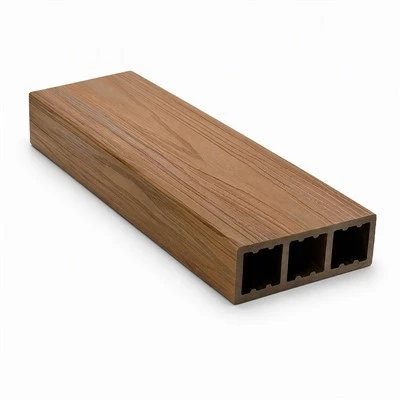
Composite decking is widely used for terraces, balconies, pool surrounds, hospitality projects and public outdoor spaces because it combines a timber-like appearance with lower maintenance requirements. But like other polymer-based building materials, WPC decking expands and contracts when temperature changes.
For homeowners, this may seem like a minor installation detail. For contractors, developers and wholesale buyers, however, thermal movement should be considered during product selection and project planning.
Does Composite Decking Expand and Contract?
Yes. Composite decking can expand as its temperature rises and contract as it cools.
The movement is generally more noticeable along the length of the board than across its width. This is why installation systems need sufficient space at board ends, walls, posts and other fixed structures. If boards are installed too tightly, temperature-related movement can create pressure within the deck and may contribute to buckling, distortion or uneven joints.
The exact amount of movement depends on the formulation, board length, installation temperature and local climate. There is no universal expansion gap that should be applied to every composite decking product.
How Much Expansion Gap Does Composite Decking Need?
This is one of the most common questions when planning a WPC decking project.
The correct gap should come from the manufacturer's installation specification rather than from a generic rule. For example, published installation guides from different composite decking manufacturers specify different end gaps according to board temperature and product construction.
Several factors should be considered:
Board length
Installation temperature
Expected seasonal temperature range
Direct sunlight exposure
Decking color
Material formulation
Joint and fastening system
Distance from walls and permanent structures
Longer boards and larger temperature changes generally require more attention to longitudinal movement. Darker boards can also reach higher surface temperatures under direct sunlight than the surrounding air temperature, which affects expansion calculations.
For commercial projects, this is particularly important when large areas are installed continuously.
Why Do Composite Deck Boards Buckle?
Insufficient expansion space is one possible cause.
Imagine a long run of boards installed during relatively cool weather with very small end gaps. As the boards heat up, they need room to move. If the surrounding structure prevents that movement, compression can build up within the decking system.
Poor subframe preparation, incorrect fastening, inadequate ventilation and unsuitable installation practices can also contribute to movement problems. For this reason, thermal expansion should be treated as part of the complete decking system rather than as an isolated board characteristic.
A good installation plan considers the deck board, subframe, fasteners, joints and site climate together.
Does WPC Decking Work in Hot Climates?
WPC decking can be used in hot climates, but the product should be selected and installed according to local conditions.
High solar exposure can raise board temperatures considerably, while large day-to-night or seasonal temperature changes increase the amount of thermal movement that the installation system needs to accommodate. Manufacturer guidance should therefore be checked for projects in regions with strong sunlight, high summer temperatures or wide temperature variations.
Material formulation also matters. NaturWing's wood composite decking uses a specified blend of 60% wood fiber, 35% HDPE and 5% additives, with the product designed for commercial and large-scale outdoor applications.
What Should B2B Buyers Check Before Ordering Composite Decking?
For a residential buyer, appearance and price may be the main considerations. Procurement teams need to look further.
Before placing a bulk order, it is worth checking:
Material composition: Ask what wood fiber, polymer and additives are used and whether the formulation is consistent between production batches.
Water performance: NaturWing lists water absorption below 0.5% for its wood composite decking, an important consideration for outdoor environments.
Surface design: Deep embossing and 3D wood-grain finishes can provide a more convincing timber appearance while supporting slip-resistant surface requirements.
Thermal movement: Request the manufacturer's expansion and contraction guidance for the actual board profile and local installation conditions.
Fire performance: For commercial and public projects, verify the applicable fire-rating documentation rather than relying only on general product descriptions.
Supply capability: Large projects need consistent color, dimensions and material performance across multiple production batches.
How Can Manufacturers Improve Decking Stability?
Thermal expansion cannot simply be eliminated from a polymer-containing composite material. A better approach is to control the variables that affect installation performance.
This starts with consistent raw-material ratios and extrusion conditions. Board dimensions, profile design, surface treatment and fastening systems also influence how the finished decking behaves on site.
NaturWing's production approach is aimed at commercial and project-based supply, with a focus on batch consistency and large-volume orders. Its wood composite decking is positioned for developers, wholesalers, architectural firms, hospitality projects and public infrastructure.
The company also provides OEM/ODM support, including customized molds, surface textures and private-label packaging for international distribution channels.
Why Choose NaturWing for WPC Decking Projects?
For overseas B2B buyers, purchasing decking is not only about finding a competitive unit price. A reliable supplier needs to support product consistency, customization, technical specifications and repeat supply.
NaturWing operates as a direct manufacturer and states that it exports to more than 40 countries, including the USA, Germany, UAE, Australia and Saudi Arabia. Its listed production capacity includes a 20,000 m² manufacturing facility, with typical bulk-order lead times of 20–30 days.
Its product range also extends beyond decking to WPC wall cladding, PVC wall panels, SPC wall panels, composite fencing, WPC flooring, decorative stone and facade products, mounting systems and hardware, allowing buyers to source complementary architectural materials from the same supplier.
For distributors and project contractors, this broader product structure can simplify sourcing when several exterior or interior finishing materials are required for one project.
Final Takeaway
Thermal expansion is a normal characteristic of composite decking, not necessarily a sign of poor product quality. The key is to control how that movement is accommodated.
For a successful WPC decking project, buyers should consider the material formulation, board length, local climate, installation temperature, expansion gaps, fastening system and subframe design together.
For large commercial or residential developments, working with a manufacturer that can provide product specifications, consistent production and OEM support can reduce problems further down the supply chain.
NaturWing supplies wood composite decking and related architectural materials for international wholesalers, developers, contractors and private-label brands. For project specifications or bulk sourcing, buyers can request product details and OEM/ODM support directly from the manufacturer.