

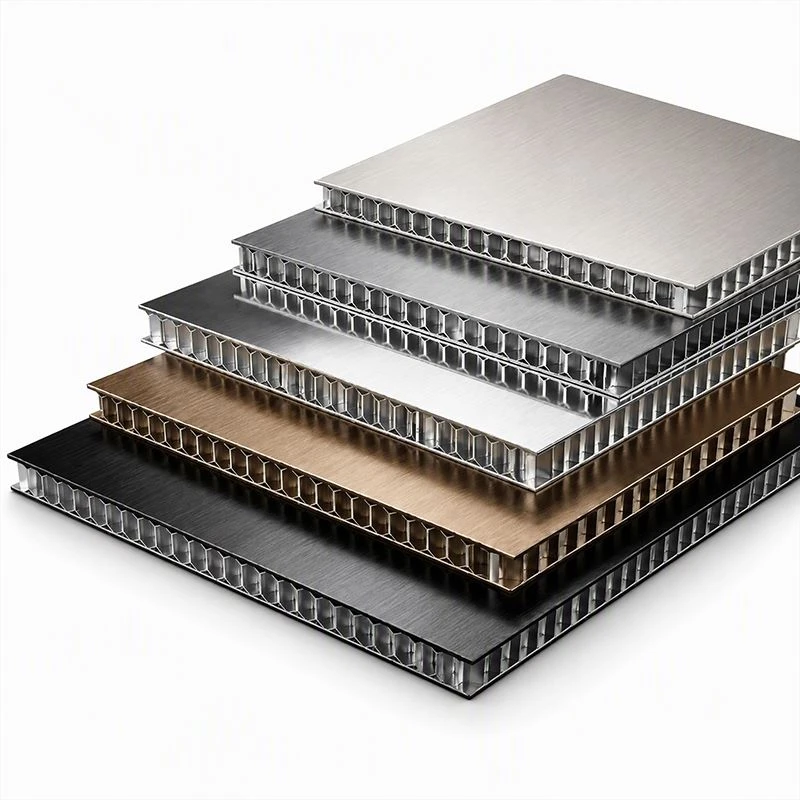


Aluminum Honeycomb Panel - Lightweight Flat-Rigid Composite Panel for Ventilated Facades, Elevator Cabs & Interior Linings

Aluminum Honeycomb Panel - The Professional Choice for Curtain-Wall Fabricators, Elevator & Fit-out Contractors and Metal Panel Distributors
Aluminum Honeycomb Panel is a sandwich composite in which two thin aluminium face sheets are bonded to a hexagonal aluminium honeycomb core. Inspired by natural honeycomb geometry, the structure delivers high bending and compressive strength at a fraction of the weight of a solid panel of the same thickness. It is engineered for curtain-wall and cladding fabricators, elevator and interior fit-out contractors and metal panel distributors, and is supplied in single-side, double-side and full-aluminium configurations so panel cost can be matched to how much of each face is actually visible.
Most honeycomb enquiries start with a weight problem that turns into a cost question. Once the panel is light enough for the frame, the next decision is how much structure the job actually needs - a back-of-house cabinet and a mirror-finish high-rise elevation should not be buying the same build.
That choice is made from three variables. Face sheets run 0.3mm, 0.5mm and 1.0mm; the hexagonal core is expanded in 6mm, 8mm and 10mm cells; and overall thickness runs 8–20mm, so stiffness per unit of weight is tuned to the span rather than bought by adding metal. The bond between face and core is what holds a large sheet dead flat, which is the property that decides whether an elevation reads cleanly under raking light.
The manufacturer is Hangzhou Feihuang Industry Co., Ltd. Its honeycomb panels are made in Hangzhou, China and sold abroad as naturwing. Coil coating, core expansion, bonding and final cutting belong to one operation, which is why a facade package and its matching interior linings come out to a single finish reference rather than being bought from two production chains.

Key Product Specifications
|
Parameter |
Data |
|
Primary Buyer Types |
Facade & Curtain-Wall Contractors, Cladding Fabricators, Elevator & Fit-out Contractors, Metal Panel Distributors |
|
Key Export Markets |
Middle East, Southeast Asia, North America, Western Europe, Australia |
|
Construction |
Aluminium face sheets + hexagonal aluminium honeycomb core; single-side / double-side / full-aluminium |
|
Panel Thickness |
8–20mm (custom thickness on request) |
|
Face Sheet Thickness |
0.3mm (ultra-thin) / 0.5mm (standard) / 1.0mm (heavy-duty) |
|
Core Cell Size |
6mm (heavy-duty) / 8mm (standard) / 10mm (ultra-thin) |
|
Max Panel Size |
2400 × 1200mm standard; up to 3600 × 1220mm on request |
|
Weight |
3–8 kg/m² (single-side) · 5–12 kg/m² (double-side) · approx. 1.5 kg/m² (full aluminium, 1220×2400×7.5mm) |
|
Surface Finishes |
PVDF coating, polyester coating, anodized, mirror, brushed, SPC facing (1,000+ finishes) |
|
Fire Rating |
Class A non-combustible / Class B1 (GB 8624, EN 13501-1) |
|
Formaldehyde Emission |
E0 |
|
Certification |
ISO 9001 · SGS · CE |
|
MOQ |
100 m² (first order) |
|
Reference Price Band |
≈US$2.10–100 per m² by thickness, structure and finish (market survey range; the exact figure depends on the build and the finish) |
|
Packing |
Wooden pallet + carton + corner protectors |
|
Delivery |
10–15 days after deposit |
|
Core Selling Points |
Honeycomb Core Rigidity at Minimum Weight · Class A Non-Combustible · Dead-Flat Large Format · Anodized / Mirror / Brushed Finishes · Three Cost-Matched Configurations |
Why Specification Buyers Choose Aluminum Honeycomb Panel
1. Honeycomb Core : Maximum Rigidity at Minimum Weight
The hexagonal core achieves high compressive and bending strength with minimal material, so a honeycomb panel is far lighter than a solid panel of the same thickness while staying flatter over long spans.
Key Benefits:
Mass comes off the frame : fewer kilos per square metre means less sub-frame and smaller anchors
Two hands instead of a hoist : panels are carried and offered up by hand on most elevations
Stiffness bought without metal : the cell geometry does the work that extra thickness would
Long spans stay supported : deflection is controlled without visible stiffeners behind the panel
Retrofit options open up : existing frames can often be re-clad rather than replaced
On high-rise and retrofit facades the weight of the cladding drives the sub-frame and anchor design - a lighter panel simplifies the engineering package and can eliminate strengthening work.

2. Class A Non-Combustible : Clears Facade Fire Submittals
Non-combustible aluminium faces and core meet Class A fire rating, with E0 formaldehyde emission for interior work.
Key Benefits:
Class A non-combustible : faces and core are both aluminium, so nothing in the build feeds a fire
E0 formaldehyde emission : the declaration the interior and clean-room specifications ask for
Third-party test documentation : the paperwork is ready before it is asked for
One build, interior and exterior : the same specification covers a facade and a cab lining
Nothing to value-engineer away : the classification survives the first review of the specification
Facade fire classification is the first gate on commercial and high-rise submittals - a Class A panel stays in the specification instead of being value-engineered out.

3. Dead-Flat Large Format : No Oil-Canning on Long Elevations
The sandwich structure resists the waviness and "oil-canning" that shows up on thin solid aluminium when viewed at a grazing angle; large 2400×1200mm and 3600×1220mm formats reduce the number of joints across long elevations.
Key Benefits:
Reflections that stay straight : mirror and gloss finishes keep their line across the sheet
Fewer joints on a long run : large formats pull the joint count down and steady the rhythm
Fewer fixings to set : fewer panels means fewer setting-out points and less adjustment
Gaps that read even : joint widths stay consistent from the first panel to the last
Shorter snagging list : waviness is the defect that usually drives the reinspection cycle
Visible waviness is the most common cause of facade snagging lists - flat panels cut the rework-and-reinspection cycle on handover.

4. Anodized, Mirror, Brushed and PVDF Finishes : Metal Interiors and Exteriors from One Panel
Over 1,000 finish options cover PVDF for exterior weathering plus anodized, mirror and brushed treatments for elevator cabs, lift lobbies, partitions and shopfronts.
Key Benefits:
Exterior and interior from one range : the facade finish and the cab finish are ordered together
Tone held between packages : the interior linings match the elevation instead of nearly matching it
Anodized and mirror for interiors : the finishes that look like metal, not like paint
PVDF where weather is the driver : the exterior-grade finish for exposed and coastal elevations
One finish schedule, one reference : a single approved control sample governs every package
Combining the facade and the interior metal package with one supplier removes interface risk between two trades on the same project.

5. Three Configurations : Match Panel Cost to Visibility
Single-side (one finished face, open/plain back), double-side (both faces finished, symmetrical, warp-free) and full-aluminium (approx. 1.5 kg/m²) versions let you quote the correct structure for walls, ceilings, elevator cabs, cabinets and clean rooms.
|
Certification |
Market / Standard |
Value |
|
Class A non-combustible |
GB 8624 / EN 13501-1 |
The classification facade submittals are assessed against |
|
E0 formaldehyde emission |
Europe & Asia |
The interior-air declaration cab and clean-room work requires |
|
ISO 9001 |
Worldwide |
Quality system certificate covering the panel range |
|
SGS third-party testing |
Worldwide |
Independent reports available for the project file |
|
CE |
European Union |
Conformity documentation for EU-market facade and lining packages |
Key Benefits:
Pay only for the visible face : single-side is the right build where the back is never seen
Symmetry where both sides show : double-side keeps a partitioning panel true from either face
The lightest build for cabs : full aluminium at roughly 1.5 kg/m² suits weight-critical interiors
One supplier across price points : decorative and functional specifications quoted from the same range
Structure matched to the drawing : configuration is chosen per application, not per project
Staircasing the structure by application lets a distributor cover decorative and functional price points without adding a second supplier.
Pain Points
|
Pain Point |
How naturwing Solves It |
|
Cladding weight drives the whole sub-frame design |
A sandwich panel at 3–12 kg/m² takes mass off the frame and the anchors |
|
Thin single-sheet metal shows waves under raking light |
The bonded hexagonal core holds the face flat right across the sheet |
|
The fire review stops the package before it is priced |
Class A non-combustible evidence is issued with the quotation |
|
Interior linings need an emission declaration |
E0 formaldehyde data supplied for cab, cabinet and clean-room work |
|
Facade metal and interior metal bought from two suppliers |
One range covers the exterior cladding and the interior details |
|
Every application quoted at the same structure cost |
Three configurations let you price to what is actually visible |
Application Scenarios

Residential
Private villa elevations and porte-cochères, balcony soffits, feature entrance walls

Commercial
Office and hotel elevations, shopfront surrounds, elevator-car interiors and lobby linings

Public Spaces
Terminal elevations, hospital and campus facades, sports hall cladding, controlled-environment rooms

Landscape Architecture
Canopy undersides, car-park screening fins, station and stadium soffits

Multi-Family
Entrance halls and shared corridors in blocks of flats, podium and car-park soffits
Installation Guide

Product Comparison: Honeycomb Panel vs Solid Aluminium Sheet & ACP
|
Feature |
Solid Aluminium Sheet |
Aluminium Composite Panel |
Aluminium Honeycomb Panel (naturwing) |
|
Weight at Equal Thickness |
Full sheet weight |
Lighter - bonded to a mineral or polymer core |
Lightest - hollow aluminium core |
|
Flatness under Raking Light |
Waves and oil-canning show |
Flatter, but the core is softer |
Dead-flat across large formats |
|
Stiffness |
Needs folding and stiffeners |
Moderate |
High, from the hexagonal core |
|
Fire Performance |
Metal and non-combustible |
Set by the core material |
Class A non-combustible aluminium throughout |
|
Core Material Risk |
None |
Mineral or polymer core drives the fire class |
Aluminium core only |
|
Finish Options |
Powder coat or anodized |
Wide, from coil coating |
PVDF, polyester, anodized, mirror, brushed, SPC |
|
Interior Emission |
None |
Core-dependent |
E0 formaldehyde |
|
Fabrication |
Folded and stiffened on site |
Cut and routed |
Cut, routed and folded to drawing |
|
Cost by Configuration |
One structure only |
One structure only |
Single-side, double-side or full aluminium |
Company Strength

Honeycomb panels for the facade and interior ranges are produced by Hangzhou Feihuang Industry Co., Ltd. at its Hangzhou works in China, and reach export buyers through the naturwing brand. Coil coating, core expansion, bonding, cutting and routing sit inside one production chain, which is what allows a facade schedule and a matching cab schedule to be released from a single finish reference.
Our Manufacturing Capabilities:
Coil coating and honeycomb core expansion carried out in-house
Face sheet, core cell and adhesive selected together for the span in question
Panels cut, routed and folded to the fabrication drawing before despatch
Anodizing, mirror and brushed finishing on the same production site as the bonding
Facade sheets and weight-critical cab formats produced on one line
ISO 9001, SGS and CE documentation held across the panel range
Quality Assurance:
Bond peel strength checked on a sample taken from each production batch
Core density and cell geometry verified against the specification
Panel flatness measured before packing rather than on arrival
Finish colour compared with the approved control sample
Pallet labels carry batch, thickness and finish for site traceability
A fire-class and emission certificate set travels with the consignment
Ready to Order naturwing Aluminum Honeycomb Panels for Your Project?
Share the elevation and the finish schedule; we will reply with a panel build - face thickness, core cell, configuration and cut sizes - priced as one schedule, with the finish held against a single approved control sample across every package on the job.
Contact us today for:
Panel samples in the build and finish you are specifying
Pricing by thickness, core cell, configuration and finish
Cut and routed panel schedules taken from your fabrication drawing
Matching interior linings quoted alongside the facade package
Certificate set : Class A fire class, E0 emission, ISO 9001, SGS and CE

Our Certificates


FAQ
Q: What is the smallest order you will take?
A: 100 square metres for a first order. Panels are cut to the fabrication drawing, so the schedule is usually driven by the number of formats rather than by area alone.
Q: What thicknesses are available?
A: 8–20mm as standard, with custom thickness produced to order. Thickness is chosen with the span and the fixing detail, not on its own.
Q: Which face sheets and core cells go together?
A: Face sheets in 0.3mm, 0.5mm or 1.0mm, with core cells expanded in 6mm, 8mm or 10mm. Heavy-duty work pairs a thicker face with a 6mm cell; ultra-thin builds use the 10mm cell.
Q: What is the largest panel you can supply?
A: 2400 × 1200mm as standard, and up to 3600 × 1220mm on request. Large formats are the reason the panel is bonded rather than folded.
Q: How heavy is the panel?
A: 3–8 kg/m² in single-side build, 5–12 kg/m² in double-side, and roughly 1.5 kg/m² for full aluminium at 1220×2400×7.5mm. Weight is quoted with the configuration because it changes with the build.
Q: Which configuration should I specify?
A: Single-side where only one face is seen, double-side where both faces are exposed or the panel must stay symmetrical, and full aluminium where weight is the constraint - elevator cars, cabinets and controlled-environment rooms.
Q: What coating and metal finishes can I choose from?
A: PVDF and polyester coil coating for exterior work, plus anodized, mirror, brushed and SPC facings. Over 1,000 finishes are held across the range.
Q: What fire and emission documents come with an order?
A: Class A non-combustible classification to GB 8624 and EN 13501-1, the E0 formaldehyde declaration, and third-party test reports for the project file.
Q: What is the lead time and how is the panel packed?
A: 10–15 days after deposit. Panels ship on wooden pallets with cartons and corner protectors, so the edges and the finished face arrive undamaged.
Hot Tags: aluminum honeycomb panel, China aluminum honeycomb panel manufacturers, suppliers, factory


